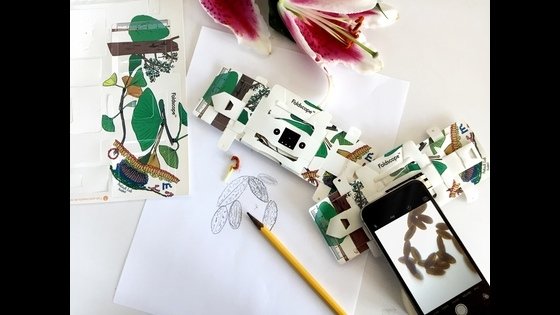
Created by Foldscope - Manu Prakash & Jim Cybulski
See the invisible with a powerful yet affordable microscope that fits in your pocket. Curiosity, discovery, and science for everyone!
Latest Updates from Our Project:
Let's Concentrate! Introducing the Nylon Filter Sheet
over 9 years ago
– Fri, Jul 21, 2017 at 11:50:05 PM
Today, we’d like to explain a little bit more about a very simple-looking Foldscope accessory that is actually a very powerful tool for exploring the microcosmos.
We are of course talking about the nylon filter sheets, of which we have produced three types with different pore sizes: 5 microns, 25 microns and 100 microns. These will be provided in every deluxe individual kit and 100 club classroom kit.
From bottom left to upper right: 5, 25, and 100 micron filter sheets
These filters enable you to do a very important step in your sample processing for Foldscope: concentration. I’m not talking about paying attention in class, but instead about taking a water sample where the interesting creatures may be sparse or “diluted”, and concentrating them down so that when you sample a drop of this water under the Foldscope, you will be more likely to find interesting life forms.
So how does this work?
To understand, we will need to dive into the microscopic scale…
Take a look at this diagram from the John Innes Center:
Foldscope, a light microscope, is supplied with a 140x lens that provides 1.9 micron resolution. This is about the size of a bacterium, and bacteria are indeed visible under the Foldscope (appearing usually as small swimming dots):
However, most eukaryotic cells (which includes animal cells, plant cells, parasites like malaria, and other cells) are much larger than bacterial cells, in the 10-20 micron range, and often bigger. Water and soil samples contain an amazing diversity of eukaryotic protozoa in this size range.
This is where the nylon filters come in handy! For instance, a 5 micron filter will trap anything larger than 5 microns, which will include almost all unicellular protozoa. You can pour a liter of pond water through a filter (for instance, one folded into a funnel, see picture below) and bring all the life forms into a few biodiversity-rich drops. This is phenomenal for surveying all the microscopic life forms present in a given environment quickly.
5-micron filter sheet folded into a funnel for concentrating a water sample
To prove this concept, check out the following life forms we found in one single drop of water after doing the concentration experiment (full post here) :
The different filter sizes allow you to set your bar at different places. For instance, if you want to isolate only multicellular life forms, like tardigrades, rotifers, or nematodes, you can choose a larger filter size, such as 25 or 100 microns.
With the help of accessories like the nylon filters, as well as one million Foldscopes in circulation, we’re eager to see what amazing things our users will be able to find…
Here is a sampling of the Foldscope "tree of life" so far:
Happy exploring!
The Foldscope Team (Manu, Jim, Honomi, Christine, Max, Alice, and Rebecca)
Bigger and Brighter: Introducing The LED/Magnifier!
over 9 years ago
– Wed, Jul 19, 2017 at 01:01:53 AM
Note: as we approach the delivery of Foldscopes, we want to showcase all the different parts we have been developing for use with the microscope! In the process we will talk about what each part does, why we were inspired to make it, and what the design process was like.
In this first installment, let’s talk about the custom LED/magnifier piece we are including in every kit…
The “/” sign in the name of this piece indicates that it might have multiple functions – and so it does!
Every microscope needs a light source, and Foldscope is designed to accommodate a variety of different lighting sources. The back of the microscope has a pinhole where light enters; this can be sunlight, ceiling light, lamplight, or a flashlight. In fact, part of the fun of playing with Foldscope is exploring how different lighting conditions affects the type of image you get, and the more expert you become at this the wider variety of effects you can approximate. Please see this post on our community website, Microcosmos, for demonstration, or watch the video below to see how changing the angle of a Foldscope with respect to a table lamp can change imaging from brightfield → phase contrast → darkfield.
But sometimes, you are in a place with no sunlight or ceiling light or lamplight and you still want to use your Foldscope. Perhaps you are in a dusty bar and want to show your friend the nuclei in their own cheek cells (speaking from experience here). The LED/magnifier can solve this problem by providing a small battery-powered light (the battery is safely enclosed inside the unit and can be replaced). We’ve designed this version to magnetically snap onto your Foldscope. It has two different brightness settings, and you can modify the light source further by adding a small piece of paper or a sticker as a diffuser. With the brightest setting you can even use your Foldscope in camera lucida mode to project your microscopic images onto a large surface – see fun example here from the Foldscope pilot project.
Finally, to adjust between brightfield and darkfield techniques with the LED, you can change the angle of illumination with respect to the Foldscope by sliding the magnetic coupler along the track of the LED/magnifier unit (see video below!)
But what about the MAGNIFYING part of this tool? The idea for including this function came from trying to isolate larvae and other small creatures from aquatic samples to put them under the Foldscope. You may have a petri dish with the most interesting creature swimming around but it is no use if you can’t catch the little bugger to put it under the microscope. A small magnifying glass (3-10x) can help tremendously in trying to find the creature you are interested in before you zoom in up close with the Foldscope. Or perhaps you are trying to dissect the mouthparts of a mosquito to prepare a microscope slide, but need a little boost to the naked eye? Again, a magnifying glass can come in quite handy.
The idea for combining the LED and the magnifying glass into one piece came from those credit-card sized magnifiers with LEDs included. This one from Amazon (https://www.amazon.com/Credit-Card-Size-Pocket-Magnifier-Light/dp/B009SE8KII) advertises its use for “menus in dark restaurants” and “night-time map reading”. Using this concept, we proto-typed our own version with 3D-printed parts, incorporating an easy way for it to snap on and off the Foldscope.
For our Foldscope LED/magnifier, we might say it is useful for “analyzing your drinking water in dark restaurants,” or “night-time microcosmos exploring” :)
-The Foldscope Team (Manu, Jim, Max, Christine, Honomi, Alice, Rebecca)
Update - Free Shipping on BackerKit add-ons
almost 10 years ago
– Fri, Jan 13, 2017 at 11:48:10 PM
Dear backers,
We have an exciting update for you!!
We do not want shipping costs to be a deterrent for adding on extra Foldscope kits to your order, so we are excited to announce free shipping on all BackerKit add-ons!
Shipping will be on an optional basis: if you would like to help us with the shipping cost of your item, we ask for $4 US/$10 international for deluxe individual kits, and $5 US/$12 international for basic classroom kits.
The shipping for the original Kickstarter pledge will remain, but all add-ons will have free shipping.
Roughly 80% of you have already completed the survey, so here is what you need to do to recover your shipping costs:
***go to foldscope.backerkit.com, where you will be able to edit your survey responses, if your pledge has not already been lowered to reflect the change in shipping. Remember that if you would like to optionally help us with shipping of your add-ons, we appreciate it greatly!
All the best,
Manu, Jim, Max and Christine
BackerKit surveys coming today!
almost 10 years ago
– Mon, Jan 09, 2017 at 10:31:48 PM
Dear Foldscope Community!
Thank you again for such tremendous support during our Kickstarter campaign! You are truly enabling us to bring curiosity-driven science to a much wider population. We hope you will get great use out of your Foldscope and will see the impact it has on the classrooms and organizations where it is implemented.
The next step to getting your Foldscopes/sending out your donations, is to fill out our BackerKit survey.
Later today, we will send an email with a special link to BackerKit surveys. This is where you will fill in shipping information and be able to add on extra Foldscope kits! It is important to respond to your survey as quickly as you can since we need this information for fulfilling your rewards.
You do not need to create a BackerKit account to fill out your survey, just click on the survey link, fill it out, and you’re all good to go! You do not have access to this survey link yet, but it will be available soon via email!
If you decide later that you want to edit your survey response (change your add-ons, update your shipping info or credit card for add-on purchases), you can go back to your survey and change it any time before we lock down the surveys for processing.
If you need to review your information or pledge status, you will be able to recover your survey here: foldscope.backerkit.com.
If you use your Facebook login for your Kickstarter account, the BackerKit survey will be sent to the email you used for your Facebook account. If you have another email address that you would prefer to use, please contact support at foldscope.backerkit.com/faq and we'll get you sorted out!
All the best,
-Foldscope Team
*Using BackerKit to fill out your survey response is optional. We are using it because it helps us out a great deal and allows us to save time and focus on fulfillment. If you do not want to use BackerKit, you can private message us through Kickstarter and we can handle your information manually.
End of campaign survey in 1-2 weeks
almost 10 years ago
– Thu, Dec 22, 2016 at 10:13:55 PM
Dear Foldscope campaign backers,
Our campaign closed yesterday and we could not be more heartened and motivated by the response we got from all of you. We raised nearly $400,000, which will go towards delivering Foldscopes to all of you and supporting the establishment of a new Foldscope supply chain, so we can begin making Foldscopes available by the millions. Ultimately, we would like to be able to reach every child in the world.
So thank you!!
Beyond the money, we gained so much from engaging with all of you as a community. We got useful advice and were inspired to hear about new settings where Foldscopes could make a difference; from Lebanon, where schools for Syrian refugees hope to provide a stable education to displaced children, to the Gulf of Mexico, where researchers study the effects of oil spills on biodiversity, and engage local communities in this effort.
Please look out for the backer survey, which will be e-mailed to you in 1-2 weeks. Make sure the email address you have on file with Kickstarter will still be functional at this time. If not, you can change it in your account settings on Kickstarter. Filling out this survey is required for you to get your Foldscope kits delivered. In this survey, you will give your shipping address and direct your donation, if you were one of the many generous backers who chose to support schools and organizations with these microscopes.
To stay in touch with us going forward, you can reach us here or find us on Twitter, Facebook, or by signing up for our email newsletter (which will have information on upcoming workshops, special offers, and will showcase the finest work in the Foldscope community).
Thank you for your early support of our project. Together we will work to inspire curiosity in our society and create a generation of tinkerers, explorers, and creative minds.
We use essential cookies and our own first-party analytics to run BackerKit. With your consent, we also use cookies to measure our marketing and share data with advertising partners to show you relevant ads. Accept to allow all cookies, or reject to turn off the optional ones.
Read our cookie policy.